
Rebuilding the Lab Workforce: A Narrative Look at Today’s Challenges, Progress, and What Comes Next
By - November 10, 2026

Clinical laboratories across the United States are standing at a crossroads. Five years after the seismic disruptions of the COVID‑19 pandemic, the lab industry is showing signs of recovery — but also revealing deeper cracks in the workforce pipeline that extend far beyond temporary strain. Recruitment remains slow, vacancy rates persist above prepandemic levels, wages have plateaued, and the morale of laboratory professionals continues to hinge on staffing stability and long-term career pathways.
Yet amid these challenges, there is clear movement. Morale is rising. Staffing levels are improving. Visibility of the profession is growing. And labs, policymakers, and professional organizations are increasingly aligning around one shared reality: strengthening the laboratory workforce is no longer optional — it is foundational to the future of American healthcare.
This article brings together new data from ASCP’s 2024 Wage & Vacancy Survey, Lighthouse Lab Services’ 2025 Wage & Morale Report, the American Clinical Laboratory Association’s 2025 economic impact analysis, and national workforce data from the U.S. Bureau of Labor Statistics to paint a comprehensive picture of the current state of the profession.
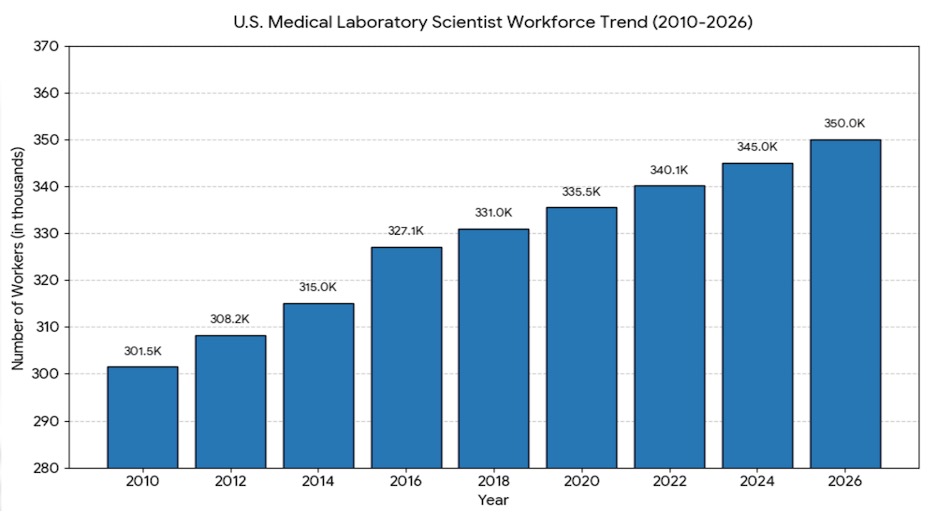
Medical Laboratory Scientist workforce trends
The workforce shows a net expansion of nearly 50,000 positions over 16 years.
Volume increases continuously due to the high volume of laboratory tests required for chronic disease management. While total positions and demand are at an all-time high, filling these open vacancies remains a critical challenge for hospitals.
Hospitals remain the dominant employer for Medical Laboratory Scientists (MLS), though workforce shortages span across both acute-care systems and independent private testing corporations.
The average national vacancy rate for medical laboratories centers around 7 percent to 14 percent, depending significantly on regional demand and departmental subspecialties, according to ASCP’s 2024 Vacancy Survey. Data collected by organizations like the American Society for Clinical Pathology (ASCP) highlights these disparities:
- Core Laboratories and Microbiology: Suffer the most critical staffing crunches, frequently climbing to 14 percent to 18 percent vacancy.
- Anatomic Pathology Departments: Experience specialized vacancy rates tracking as high as 28.5 percent.
- Turnover Rates: Driven by retirement and burnout, average hospital laboratory staff turnover sits at roughly 20.7 percent
The workforce is stabilizing, yet it is still far from fully restored.
ASCP’s 2024 Vacancy Survey reveals a workforce still under strain, even as vacancy rates decline from their pandemic peak. While progress is real, the shortages remain significant, especially in highly specialized departments (ASCP, 2024).
2024 Vacancy Rates by Department (ASCP)
Vacancies continue to be highest in:
- Anatomic Pathology
- Cytogenetics
- Flow Cytometry
- Histology
- LIS/QA/PI
- Point of Care
The data highlights several departments where vacancy pressure remains especially pronounced.
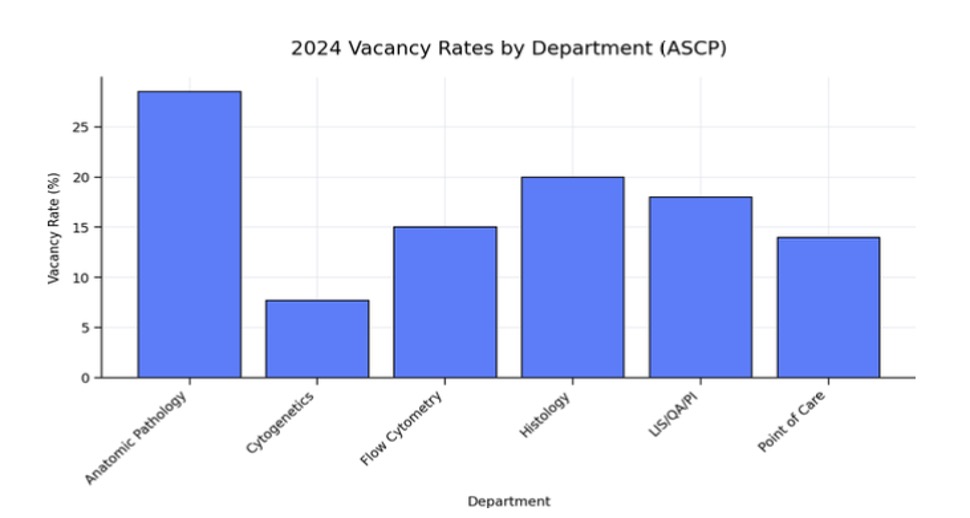
The most notable trend: even though vacancy rates dipped from 2022 levels, they remain well above pre‑COVID baselines, especially in departments requiring extensive training and certification. Supervisory hiring remains slowest, with many positions taking more than a year to fill (ASCP, 2024).
Retirement rates continue to rise across 10 of 17 departments, accelerating the urgency to rebuild the pipeline.
Morale is improving — cautiously
Against the backdrop of persistent vacancies, Lighthouse Lab Services’ 2025 Wage & Morale Report shows signs of cautious optimism among laboratory professionals. Morale is now the highest it has been since 2020 (Lighthouse Lab Services, 2025).
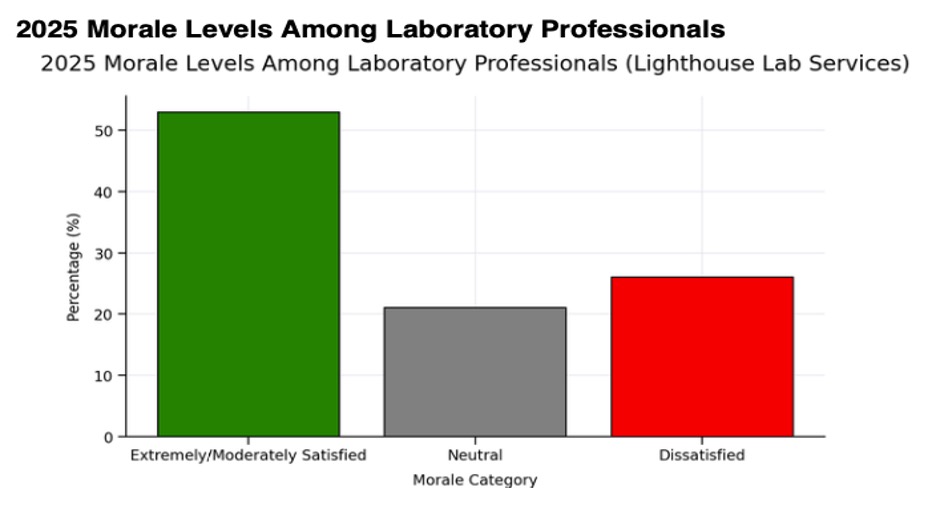
The increase in satisfaction — from 44 percent in 2023 to 53 percent in 2025 — signals a workforce rediscovering stability. For the first time, most respondents did not describe themselves as “overworked,” and nearly half rated their workload as “reasonable” (Lighthouse Lab Services, 2025). Smaller raises were common, but widespread enough to contribute to morale improvement.
Still, concerns remain:
- 53 percent report their lab is understaffed (Lighthouse Lab Services, 2025).
- 41 percent feel overworked (Lighthouse Lab Services, 2025).
- Wage stagnation persists.
- Burnout rates, while lower, remain pervasive.
- Gender wage gaps widened to 25 percent (Lighthouse Lab Services, 2025).
Despite this, professionals continue to express strong commitment to the field — especially those within their first five years of practice, a critical sign for future retention.
Key findings
Wages
Reported wages have largely stagnated, with some roles showing slight declines in average compensation compared with the prior year. Most raises were small, and many respondents said the increases did little to offset wage stagnation or rising cost-of-living pressures.
Wage gap
The gender wage gap persisted and widened. On average, male respondents reported earning 25 percent more than female respondents, up from a 23 percent gap in 2024 (Lighthouse Lab Services, 2025). The figure may be influenced by the larger share of male respondents who reported holding laboratory leadership positions.
Pipeline issues
The data reinforces the need for stronger recruitment and training programs as experienced professionals retire, and laboratories continue to compete for a limited workforce.
Taken together, the ASCP and Lighthouse findings show that compensation remains one of the clearest barriers to workforce stability. Although morale is improving, wages have largely flattened, and some roles reported slight year-over-year declines.
2025 national average annual compensation by position
Managers, CLIA lab directors, and LIS professionals continue to see the highest salaries, while technicians and accessioners remain among the lowest‑paid.
- Wage gaps expanded between male and female respondents (Lighthouse Lab Services, 2025).
- High-cost-of-living states often showed 20 percent to 40 percent higher wages (Lighthouse Lab Services, 2025).
- Raises were common: 77 percent received one, but most were only 1 percent to 3 percent (Lighthouse Lab Services, 2025).
Respondents repeatedly cited compensation and understaffing as principal drivers of turnover.
A shrinking training pipeline and the rise of international professionals
Despite increasing recognition of the critical role laboratories play in healthcare, the U.S. training pipeline continues to lag far behind demand.
ASCLS and ASCP estimate that the nation is educating less than half of the laboratory professionals required each year (ASCLS; ASCP, 2024).
Complicating the situation further:
- Training programs face challenges due to limited faculty availability.
- Clinical site availability is diminishing.
- Retirements are accelerating.
- Many programs have either closed or scaled down their operations.
Simultaneously, the workforce is becoming more diverse and multilingual. The APHL’s 2024 Laboratory Workforce Profile revealed that laboratory environments now encompass 71 distinct languages, an increase from 42 in 2022 (APHL, 2024). This surge reflects a heightened level of international participation.
Although no dataset specifically isolates “international MLS,” several recognized barriers impact internationally trained professionals:
- Visa restrictions, particularly those pertaining to J-1 and H-1B visas.
- Licensure pathways that necessitate ASCP certification.
- Ambiguous job postings, many of which fail to specify the availability of visa sponsorship.
- Challenges in securing residency placements for individuals entering pathology training programs.
These factors create both obstacles and opportunities as laboratories increasingly seek to expand their horizons beyond U.S. borders to address workforce shortages.
Labs are an economic engine. That makes workforce stability a national issue.
The workforce discussion cannot be separated from the broader economic footprint of clinical laboratories.
ACLA’s 2025 economic analysis shows the lab industry contributes the following to the U.S. economy (American Clinical Laboratory Association, 2025):
- $140 billion in annual economic output.
- 668,000+ jobs nationally.
- 311,000+ direct employees across 59,000 laboratory sites.
- $19 billion in tax revenue to federal, state, and local governments.
Labs are not just healthcare infrastructure — they are economic infrastructure.
Yet repeated Medicare cuts pose a significant threat. As ACLA warns, reimbursement instability jeopardizes the following areas (American Clinical Laboratory Association, 2025):
- Workforce expansion
- Investment in new technology
- Access to timely testing
- The ability of labs to remain competitive employers
Workforce shortages, in this context, become a policy issue as much as a labor market issue.
Signs of recovery — and what must come next
The landscape of clinical laboratories is slowly stabilizing. The industry is recovering from a generational shock, and many workforce indicators are trending in positive directions. But the path forward requires sustained investment and intentional change.
Key levers for progress include:
- Expanding training programs through partnerships with universities and health systems.
- Establishing clear career ladders to attract and retain early career professionals.
- Reforming wage structures to close gender gaps and reward advanced credentials.
- Supporting international professionals through clearer visa sponsorship pathways.
- Modernizing laboratory reimbursement to ensure labs can invest in next-generation diagnostics and staffing.
- Increasing public awareness of laboratory medicine’s role in patient care.
Laboratory professionals continue to voice one consistent sentiment: The work they do is essential, deeply meaningful, and deserving of recognition.
As one MLS put it, “I love the work — but I worry about the sustainability of staying in the profession.” This tension between professional commitment and workplace pressure defines today’s workforce debate.
A changing workforce, a critical turning point
The U.S. laboratory workforce is still recovering from the COVID-19 pandemic but still faces challenges like high vacancy rates, especially in specialized departments, and stagnant wages. While morale is improving, concerns about understaffing, burnout, and gender wage gaps persist. The ASCP 2024 Vacancy Survey and Lighthouse Lab Services 2025 report highlight these trends, emphasizing the need for workforce rebuilding.
The 2025 National Average Annual Compensation by Position report reveals that while morale is improving, wages have stagnated, with some roles experiencing slight declines. The gender wage gap has widened, with male respondents earning 25percent more than female respondents. The report highlights the need for stronger recruitment and training programs to address workforce shortages, as the U.S. training pipeline struggles to meet demand.
The workforce is stressed — but rebuilding. The challenges are real — but solvable. And with coordinated action across education, policy, and healthcare systems, the laboratory profession can emerge stronger, more resilient, and more prepared to meet the demands of modern medicine.
References
- American Clinical Laboratory Association. (2025). Economic impact of clinical labs. https://www.acla.com/economic-impact-of-clinical-labs/
- Association of Public Health Laboratories. (2024). 2024 laboratory workforce profile: Survey summary report. https://aphl.org/docs/default-source/technical/QSA-Workforce-Profile-2024-Survey-Summary.pdf
- Garcia, E., Diaz, J., Kundu, I., Kelly, M., & Soles, R. (2025). The American Society for Clinical Pathology 2024 vacancy survey of medical laboratories in the United States. American Journal of Clinical Pathology, 164(5), 759–777. https://doi.org/10.1093/ajcp/aqaf101
- Lighthouse Lab Services. (2025). 2025 wage & morale survey of medical laboratory professionals. https://www.lighthouselabservices.com/wp-content/uploads/2025/07/LLS-2025-Wage-Morale-Report-of-Medical-Laboratory-Professionals-For-Distribution.pdf
- U.S. Bureau of Labor Statistics. (2025). Clinical laboratory technologists and technicians. Occupational Outlook Handbook. https://www.bls.gov/ooh/healthcare/clinical-laboratory-technologists-and-technicians.htm
- American Society for Clinical Laboratory Science. (n.d.). Workforce resources. https://www.ascls.org

Jim Sedayao
Medical Laboratory Scientist