
Roots + Routes—Lois Snider, Roger Dimit, and Steven Dimit: A Family Legacy Built Behind the Laboratory Door
By - August 11, 2026
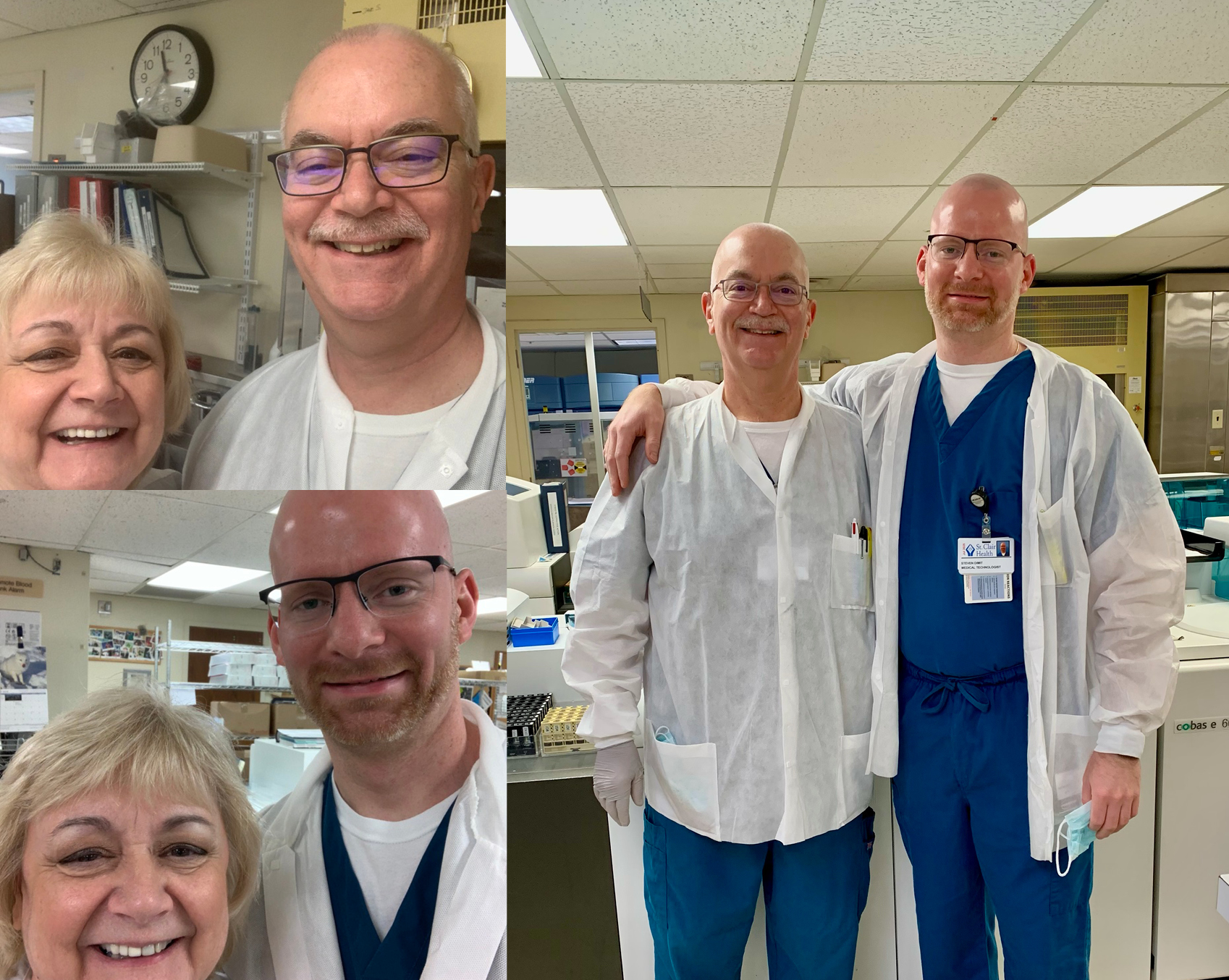
One of the most common ways to enter the laboratory is through a family member, where interest is often sparked through a demonstration of the field in person. For the Dimit/Snider family, that spark began with an uncle who worked in a hospital laboratory and grew into a family legacy spanning decades of service in laboratory medicine.
Hooked at the first look through a microscope
As a child, Lois Snider, BSMT, ASCP, age 73, now a retired point-of-care coordinator, wanted to become a nurse “to help people.” However, as a teen, a laboratory tour by her uncle, a chief technician in the laboratory at Indiana Hospital, changed the trajectory of her career before it began.
"When he took me up there through his lab, it got me hooked," she says. She remembers looking through the microscope at blood on a slide and feeling awed. Her interest in biology merged well with laboratory work.
Lois was far from the last one in her family to enter a laboratory profession. She would next influence her brother Roger.
A career detour
Roger Dimit, BSMT, ASCP, age 69, a retired medical technologist, also experienced a change to his original plan to become a physician’s assistant after graduating high school. When he found himself competing with Vietnam veteran corpsmen who already had medical training, he reflected on his sister and uncle’s careers in laboratory medicine and pivoted, finding his way into medical technology.
Driven to help others, like his sister, he also had a sense that the field was a solid career choice “because I would always have a job at it. It wouldn't be something I would be getting laid off from."
Growing up in the laboratory
Unlike his father and aunt, Steven Dimit, MLS(ASCP)CM, age 40, a medical laboratory scientist, did not need to discover laboratory medicine as a teenager or young adult—he essentially grew up in it. The hospital where his parents worked doubled as an unofficial daycare, giving him a front-row seat to the laboratory long before he considered it as a career. His mother worked as a nurse at the same hospital. “My dad worked day light and my mom was evening part time. So, to avoid babysitters and daycare, they would trade me and my brother in the lab," Steven says.
Though he considered going into pharmacy work, ultimately his love of “how complex things were” and some of the “cool instruments” he saw pushed him toward laboratory work. “At the end of the day, whatever that analyzer was doing, it was helping somebody—and that's what really stuck with me,” Steven says.
Three careers, three memorable patient stories
Although laboratory professionals often work out of public view, all three of them recall a specific patient they were able to help whose case left a lasting impression.
Steven’s rare blood discovery
For Steven, the moment came when a patient’s tests were all “pan-reactive across the board” and “even the blood type was messed up.”
When his coworker returned with the reference lab results asking if he’d heard of “anti-H,' he said, “My jaw dropped." The woman had an extremely rare blood type known as para-Bombay, so rare many people only ever learn about it in books. He said it left the whole laboratory “nerding out over this patient."
Though she didn’t need a blood transfusion at that time, if she had, he said, she would have likely received O-negative, often referred to as the universal donor, though it’s not. “That blood probably would've killed her,” he says.
The experience was a career defining moment.
Roger's first notable diagnosis
Roger’s memorable patient came when he was only two months out of college, new on the job and the only MT on in the middle of the night. "I'm doing the differential and all of a sudden I was startled. I was awake."
Roger saw something unusual in the patient’s blood and immediately placed a call over to the ER to find out the patient’s race. He believed he was seeing sickle cells, representing a type of anemia that commonly affects Black people among others.
The next morning, the pathologist confirmed that they were definitely sickle cells and added, “you made a good call.”
The patient turned out to be a fifteen-year-old Black girl who was in the throes of her first sickle crisis.
Lois's overnight emergency
Lois’s memorable patient happened when she was working night on call at nine months’ pregnant.
A call came in for a nine-year-old boy whose potassium was 1.7, which, she says “is not compatible with life."
The treatment was to give the boy potassium every hour, which kept Lois stuck at the hospital. "I spent the whole night there," she says. Colleagues took pity on her and would call her each time the doctor took a sample, so she didn’t have to stay in his room the whole time.
The boy’s potassium remained so low, the hospital ran out of the medication, and he was eventually put on a life flight to another hospital.
"Long story short, he was an undiagnosed diabetic," she says. The boy lived in a rural part of the county where healthcare was difficult to access. Though she didn’t learn of his fate, she felt hopeful that she played a key part in getting the boy necessary care.
A worthy trade off
Perhaps precisely because laboratory medicine remains underrecognized and often misunderstood, the trio firmly believe in the value of the work. They’ve loved their careers, which has brought meaningful work, intellectual challenges, and the opportunity to improve lives every day.
Though they missed a lot of holidays and family events over the years due to their jobs, Roger says he wouldn’t trade his career. “We knew that we were there helping people and that made the job worthwhile," he says.
Steven agrees that while their jobs “might not be front-page news,” it’s rewarding. “You know you’ve made a difference,” he says.
For more Roots + Routes stories, click here.

Jordan Rosenfeld
Contributing Writer